
The one-sentence version
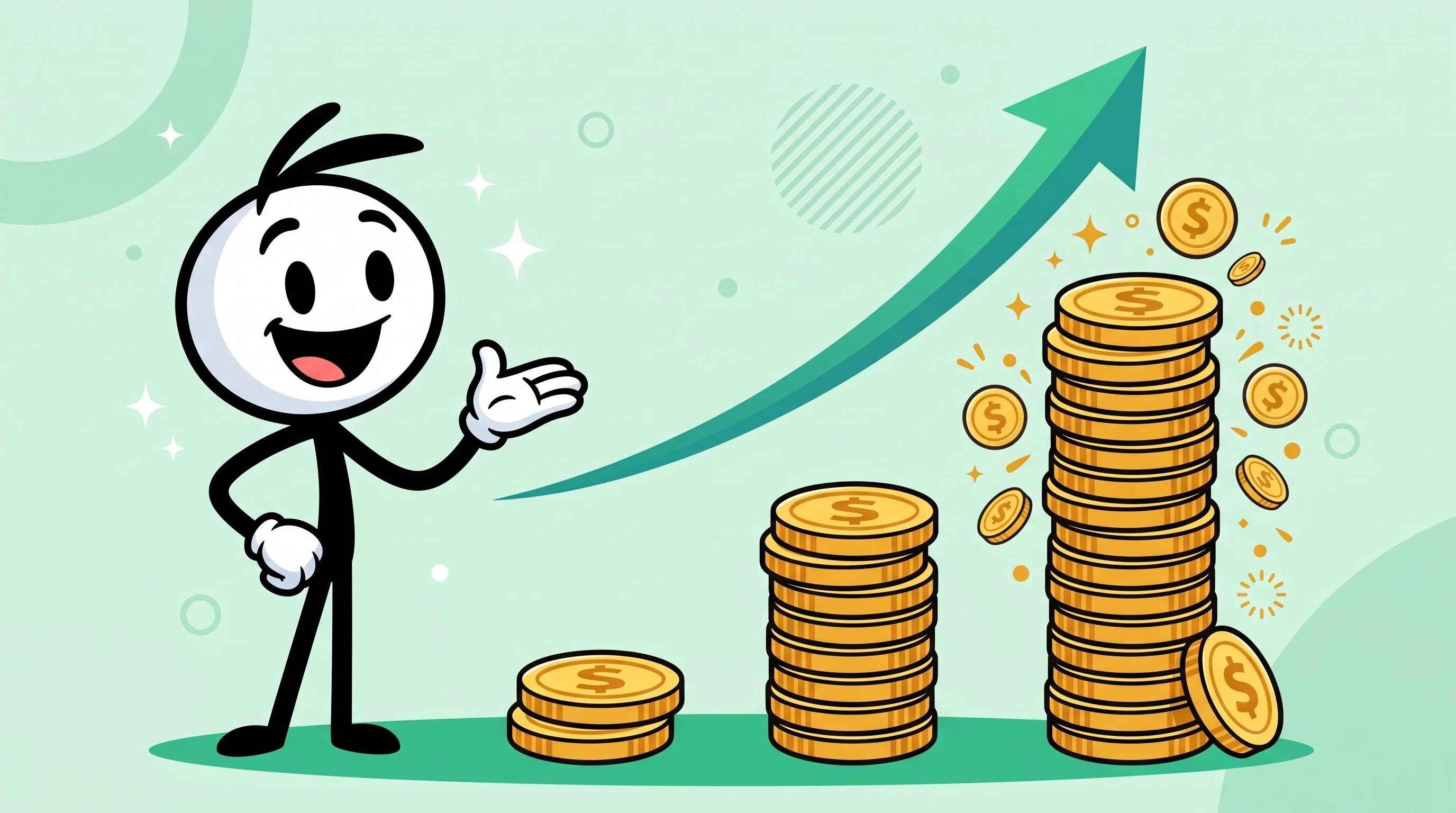
Compound interest means your returns start earning returns of their own. Each period, growth is calculated on everything already there — your original moneyplus all previous growth — so the balance accelerates the longer it runs.
A worked example
Assumptions: you invest $1,000 once, add nothing more, and earn a steady 7% per year, compounded annually, for 10 years. Taxes and fees are ignored.
- After year 1: $1,000 × 1.07 = $1,070.00
- After year 5: $1,000 × 1.075 = $1,402.55
- After year 10: $1,000 × 1.0710 = $1,967.15
Notice the yearly gains grow: $70 in year one, roughly $129 in year ten — on the same $1,000 start. That widening gap is compounding. Reproduce it in the compound interest calculatorby entering 1000, 0 monthly, 7%, 10 years, annual compounding.
Why time beats timing
Because growth feeds on itself, extra years at the end matter more than extra dollars at the start. Doubling the time horizon roughly quadruples the growth at typical rates — which is why starting modestly today usually beats starting ambitiously in ten years.
What the example leaves out
- Real returns bounce around; nothing grows at a smooth 7%.
- Inflation shrinks what the final number can buy.
- Taxes and fees take a cut the example ignores.
Projections are illustrations of an assumption, not predictions. See the methodology pagefor the exact formulas, and the disclaimer — this is general education, not financial advice.
Quick answers
Is compound interest the same as "interest on interest"? Yes — that phrase is the whole idea in four words.
Does it work for debt too? Unfortunately, yes. Unpaid balances compound against you, which is why expensive debt deserves attention first.
How often does compounding happen? It depends on the account — daily, monthly, quarterly, or annually. More frequent compounding grows slightly faster at the same stated rate; the calculator lets you compare.